
Admissions tutors are not looking for a perfect performance. They are looking for intellectual curiosity, honest reasoning, and the ability to engage with ideas under pressure. The single question running underneath every Oxford interview is: What do you think? Not what you have memorised. Not what your teacher said. What you actually believe, after reading and thinking and wrestling with a subject.
Oxford interviews are not like job interviews or school assessments. Think of them as a lesson. Tutors teach in very small groups, never more than two or three students, and the interview is essentially an audition for that environment. They want to see how well you can be taught.
There are five types of questions that come up. They move from the foundations of your subject all the way up to specific puzzles, and each level builds on the one below.
THE FIVE QUESTION TYPES
1. The Disciplinary Question
2. The Conceptual Question
Concepts are the building blocks of any subject. Words like freedom, justice, and property are used constantly in academic work, and if you cannot be precise about what they mean, everything else breaks down.
Start by deconstructing the words. What is property? Something you own, whose ownership is recognised. What makes intellectual property different from material property? It is the product of your mind rather than something physical. Then the harder question: where does it end? At what point does a piece of music stop being inspired by something and start being a copy of it? That is where the real conversation begins.
The key word is matter. Matter to whom? In what sense? Ecologically? Morally? The question sounds simple and it is not. That is the point.
3. The Theory-Building Question
This asks you to explain why something happens. You are building a simplified story about the world and defending it. You are not expected to be certain. You are expected to reason.
“Why did the Titanic initially float, and why did it then split in two?”
You will have covered buoyancy and forces in school physics. Apply those ideas here. Sketch the forces acting on the ship. Explain why something as large as an ocean liner floats while a penny thrown into a fountain sinks. Then work through why it cracked in two rather than crumbled or exploded. That narrative, told clearly with reasoning, is what a theory is.
Do not just state a conclusion. Tell the story of how you got there. Think about the mechanism. And think about not just what happened but how you would test it. That shift from what to how is one of the most important moves you can make.
4. The Methodological Question
Once you have a theory, how do you test it? No method is perfect, and tutors know that. They are looking for someone who can think through a problem systematically and evaluate the strengths and weaknesses of their own approach.
“How would you measure the weight of your own head?”
Your first instinct might be to rest your head on some scales. A tutor will point out your head is still attached to your body, so you would be holding back some weight. You might then think of dunking your head in water and measuring the displacement. But that has problems too. The question seems simple and becomes genuinely complicated very quickly. That growing complexity is not a sign the interview is going badly. It is the point of the question. Academics love that complexity.
Start by thinking out loud. The tutor will help you develop your approach. If they identify a flaw, they are not saying you have failed. They are asking you to evaluate your own thinking, which is exactly what academics do.
5. The Specific Puzzle
This is where tutors give you something with an actual answer and ask you to find it. How you get there matters far more than how quickly.
“What is the last digit of 2 to the power of 1,000?”
You cannot calculate this directly. The strategy is to simplify. Start with 2 to the power 1 (which is 2), 2 to the power 2 (4), 3 (8), 4 (16). The last digit follows a cycle: 2, 4, 8, 6, repeating forever. Since 1,000 divides evenly by 4, the final digit is 6. The answer matters, but what the tutor is watching is how you explained every step along the way.
“Enemy A poisons V’s water bottle. Enemy B drills a hole in it so the water trickles out. V later dies of thirst in the desert. Who, if anyone, caused V’s death?”
There is no neat answer. You work through it out loud. Did V know the water was poisoned? Does that change B’s liability? What is the proximate cause of death? The tutor will push you, offer alternative framings, and help you develop your thinking as you go.
“What is humanity’s greatest achievement?”
Most people say the moon landing. The most impressive answer ever given to that question was: rubbish. If you take the word great not to mean morally admirable but simply biggest, the largest thing humanity has ever produced as a species is waste. There is a mass of rubbish in the Pacific Ocean roughly the size of the United States. It is a grammatically correct, completely legitimate answer to the question, and far more original than anything obvious. The ability to take the exact language of the question and use it in an unexpected but defensible way is exactly what tutors find impressive.
The Three Things Tutors Are Measuring
While interviewing, tutors take notes on three things:
Clarity of Communication
Can you express your thinking simply and precisely, under pressure?
Coherence of Argument
Does your reasoning hold together from premise to conclusion?
Critical Thinking
Can you question assumptions — including your own?
Those three criteria run through every Oxford interview regardless of subject.
The most common mistake is not thinking poorly. It is not listening carefully. Candidates who are well-prepared sometimes use the interview as an opportunity to demonstrate how much they know, rather than actually responding to what the tutor is asking. The tutor is your best asset in that room. Listen to them.
How OSP Builds These Skills?
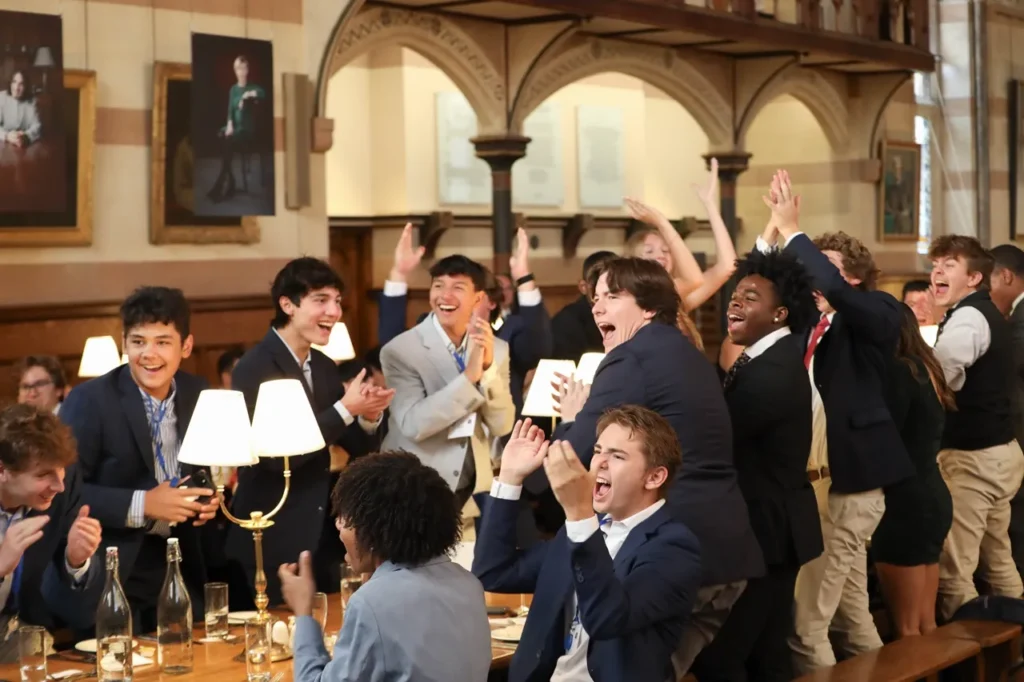
At the Oxford Scholars Programme, students spend two weeks working in small-group tutorials modelled on the Oxford teaching style. This is not lecture-based learning. It is active, conversational, and demanding.
Scholars interact directly with academics, people who sit on the other side of the admissions process. Taking part in discussions with them, not just attending their sessions, gives scholars the chance to develop a deeper understanding of their subject and to formulate arguments more coherently. You begin to understand what Oxford-level thinking looks and sounds like from the inside, which is a very different thing from reading about it.
- Law scholars debate live cases in moot court simulations.
- Medicine scholars work through ethical scenarios with no obvious right answer.
- Engineering scholars tackle unfamiliar problems in front of peers and tutors.
- Business scholars present strategies and defend their reasoning under questioning.
Prepare Before The Process Begins
Start early. Read in your subject. Oxford publishes subject-specific reading lists on its website, used by the tutors themselves and free to access. Working through even a handful of titles before your interview builds the kind of thinking that no last-minute prep can replicate.
Being in the environment matters too. Interacting with academics, taking part in real discussions with people who read applications and conduct interviews, changes how you think about your subject and how coherently you can argue. That experience is difficult to replicate anywhere else, and it shows when you walk into an interview room.
Find out how the Oxford Scholars Programme prepares students for the academic demands of university admissions and beyond.
Applications for OSP 2026 are now open.
August 2–15, 2026
Oxford, UK
Limited to 100 scholars